
The Future Briefing: 20 November 2026
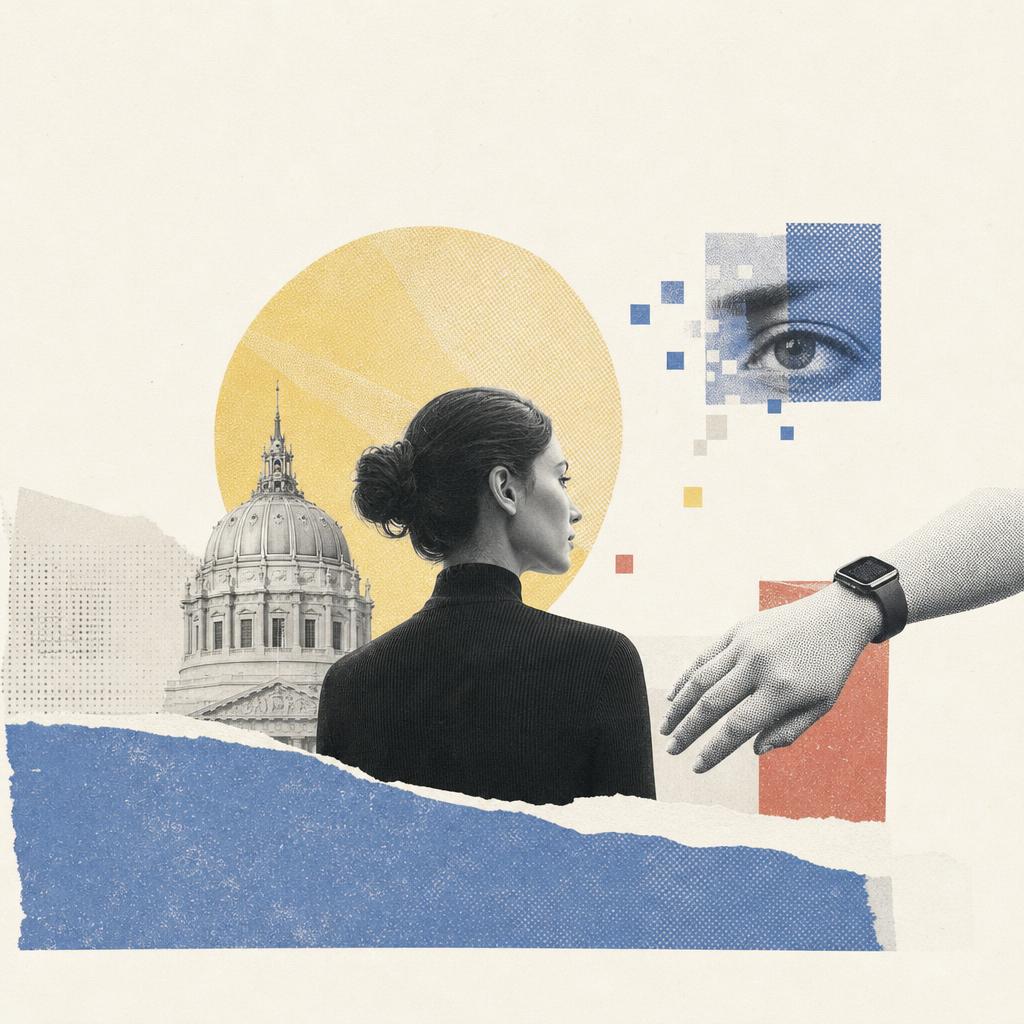
A share price, a safety assessment and a reconstructed body pose each offer a measurement, not the whole picture. Today’s developments in artificial intelligence research and commercialisation underline that distinction. Anthropic faces public-market expectations; California proposes firmer oversight; researchers tackle unreliable text detection and wrist-based motion tracking. Across them, the useful question is what each system can actually establish.
Anthropic’s market debut puts safety promises on a new scorecard
Anthropic finished its first public trading session at $97.17, up 17% against its $83 offer price, according to Yahoo Finance. Shares opened at $111.50 before retreating. The debut gives public investors exposure to the company behind Claude, but market enthusiasm does not establish technical reliability.
The report’s account of Anthropic’s filing offers a more practical picture of the business. Developer and business usage fees supplied about 79% of revenue during the first nine months of 2026; subscriptions contributed the rest. However, the company reported a $1.26 billion operating loss over that period, with computing costs a major expense.
For customers building services around its models, those economics matter alongside model performance. Meanwhile, chief executive Dario Amodei emphasised safety at the opening ceremony. The editorial test is whether that commitment remains legible in deployment decisions when quarterly growth becomes another powerful demand. A successful listing cannot answer that.
Source: Original reporting.
California proposes AI oversight with power to intervene
California has released recommendations for stronger AI oversight, including state-set baseline standards, independent testing and emergency shutdown authority. Crucially, these are proposed next steps, not evidence that every recommended power already exists. The governor’s announcement also calls for expanded incident reporting and verified containment protocols.
The proposals would require independent scrutiny throughout model training, development and deployment. They also seek authority to cap recursive self-improvement: the prospect of AI designing more capable successors without human input. However, the announcement does not itself demonstrate that such autonomous development is an established capability.
For developers, the significant change would be accountability beyond publishing their own safety frameworks. For everyone else, the practical question is whether intervention could work when needed. Shutdown authority needs technically credible procedures, clear thresholds and accountable decision-making. The state’s release makes a case for stronger controls, but its political framing and incident claims should not substitute for independent evidence.
Source: Original reporting.
AI text detectors learn to chase a moving target
Researchers at MIT and Cornell report a way to make AI text detectors more resilient as writing changes. Their technique, test-time adaptation, lets a deployed detector adjust to incoming, unlabelled text rather than remain fixed after training. That matters because unfamiliar models and deliberately disguised writing can undermine conventional detection.
In experiments involving disguised AI text, the adaptive approach caught more than 93%, compared with about 27% for existing methods. Meanwhile, tests mimicking natural changes in writing produced 85% accuracy, against 73% for traditional approaches. These are experimental results, not a guarantee for every classroom, newsroom or recruitment process.
The human stakes demand that distinction. A detection score can inform scrutiny, but should not become an automatic verdict on authorship. Moreover, the researchers acknowledge that increasingly natural AI writing could make detection fundamentally harder. Better adaptation addresses a moving target; it does not establish that human and machine writing will always remain distinguishable.
Source: Original reporting.
A smartwatch listens for the shape of your movement
EchoMotion, developed by researchers at Cornell and KAIST, uses a smartwatch’s speaker and microphone to estimate movement across 12 joints. The speaker emits ultrasound; a lightweight machine-learning model running on the watch interprets returning echoes. The approach needs no hardware modification on the commercial watches tested.
On a Samsung Galaxy Watch 6, the team reported positional accuracy within roughly four inches in laboratory conditions. A 12-minute calibration reduced that figure to around 2.4 inches. Tests also covered Galaxy Watch 7 and Pixel Watch 3 devices, with reported battery consumption of around 10–12% per hour.
For immersive experiences, the attraction is less equipment strapped to the body and less dependence on external cameras. However, estimating a pose is not equivalent to capturing every movement precisely. Narrow corridors containing other people caused difficulties. Fitness and interface applications look plausible, but comfort, reliability and the privacy implications of continuous movement inference still deserve scrutiny.
Source: Original reporting.
Common Technological Implications
These stories expose a useful distinction between making something measurable and making it trustworthy. Markets price expectations; detectors classify writing; watches infer bodies. None of those outputs removes the need for interpretation. California’s proposals address the related institutional problem: who can challenge a developer’s account of its own technology?
The design opportunity is therefore not simply greater capability. It is making uncertainty visible and correction possible. For a teacher, customer or regulator, a useful system should support informed judgement rather than demand deference. More impressive numbers can sharpen a decision, but they cannot take responsibility for it.
Listen Beyond the Headlines
Subscribe to The Future Briefing Podcast and
get notified when new episodes explore the
technologies shaping our world.
Beyond the Briefing
The Future Briefing is curated by
Adrian Posteuca,
Technology Futurist, Creative Technologist
and Founder of FutureReality.Space.
Beyond exploring emerging technologies,
Adrian delivers AI training, technology
keynotes and strategic insights that help
organisations understand what comes next.
Looking to bring the future into
your organisation?
Explore AI training, book Adrian for a
keynote or discuss a technology collaboration.
Connect with FutureReality
.