
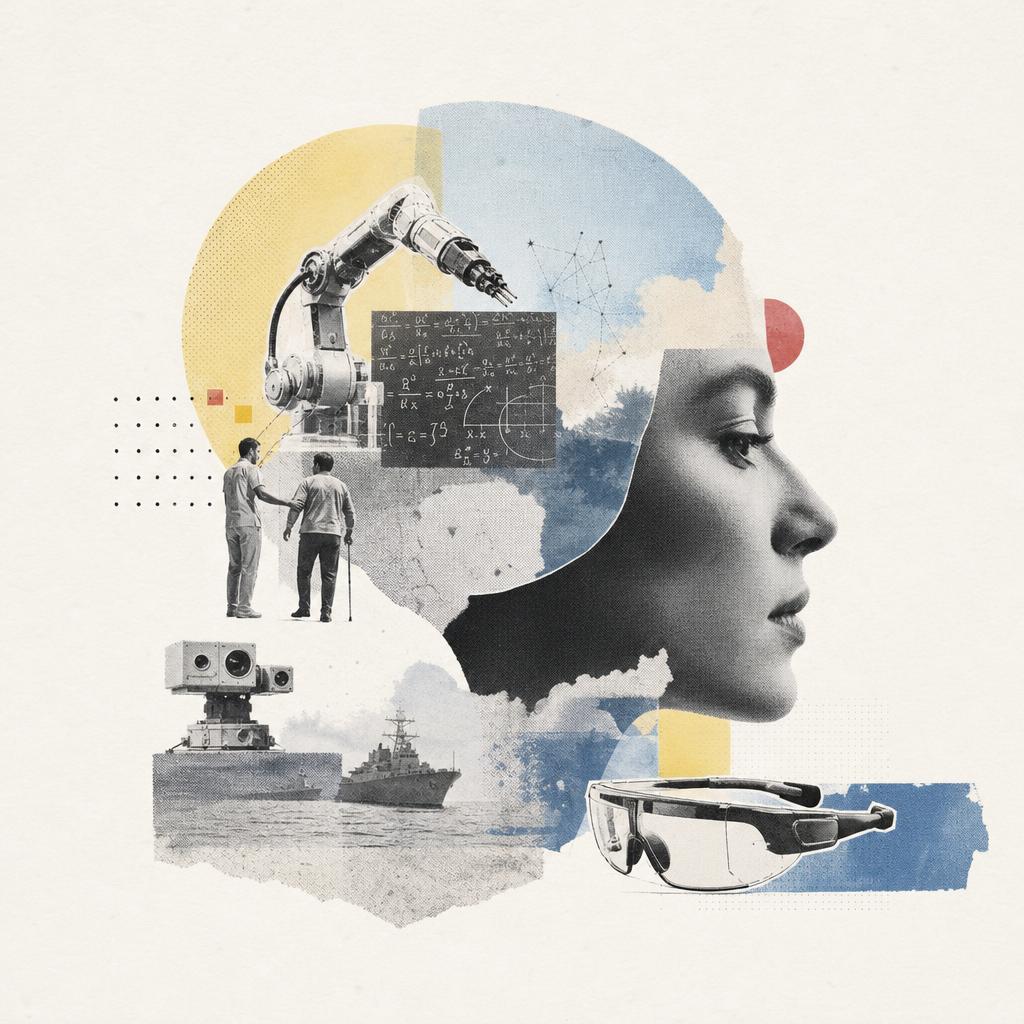
The Future Briefing: 23 November 2026
A claimed mathematical proof is not yet shared understanding; improved movement scores are not automatically greater independence. Across artificial intelligence research, stroke rehabilitation, autonomous weapons and mixed-reality glasses, this edition examines the distance between technical capability and human benefit. The developments differ sharply in stakes and evidence, but each makes the conditions of progress as important as the headline achievement.
Claude-assisted Riemann claim faces the test of mathematical scrutiny
Anthropic mathematician Levent Alpöge claims he and Claude have found a proof of the Riemann Hypothesis. The longstanding problem concerns the distribution of prime numbers. However, the Associated Press report carried by NPR describes an announcement awaiting scrutiny, not an established mathematical result.
Alpöge released the argument in 17 million lines of Lean code, a language used to formalise mathematical proofs. That format matters: formalisation can make arguments amenable to machine checking. Nevertheless, the report does not establish independent verification that the submitted code proves the intended theorem. Claude endorsing an argument is not equivalent to that verification.
The Clay Mathematics Institute still listed the hypothesis as unsolved hours after the announcement. Meanwhile, Alpöge acknowledged presenting an argument before mastering its surrounding mathematics. For researchers, the prospect is compelling but demanding: AI-generated formal work could expand discovery while leaving substantial work to establish correctness and explain why a result holds.
Source: Original reporting.
Brain-controlled rehabilitation shows promise beyond a convincing sham
A small randomised trial reports greater upper-limb motor improvements after stroke with motor-imagery brain–computer interface training. Published in PLOS One, the study assigned 32 participants to active or sham training alongside standard rehabilitation. Both groups completed 20 half-hour sessions over four weeks.
The active system used EEG signals associated with imagined swimming movements to control a robotic arm support and virtual feedback. In contrast, the sham matched the experience without linking robotic movement to participants’ neural activity. This comparison helps distinguish the contribution of that link from attention, expectations and passive movement.
Both groups improved, but the active group gained more on several motor assessments. However, the difference on the Modified Barthel Index, which assesses daily functioning, was not statistically significant. That distinction matters to patients: better movement scores do not necessarily demonstrate greater everyday independence. Larger trials with longer follow-up are needed to establish durability and clinical relevance.
Source: Original reporting.
Autonomous weapons talks advance, without agreement on binding rules
Countries meeting in Geneva agreed to further discussions aimed at developing rules for autonomous weapons within two years. However, Reuters reporting carried by Business Standard says the agreement leaves open whether those measures would be legally binding. It is a commitment to continue negotiations, not an adopted regulatory regime.
The talks concern weapons capable of identifying and engaging targets with varying degrees of autonomy. Around 100 countries supported a stronger position, while major arms-producing states including the US, Russia and Israel opposed it. Meanwhile, Russian procedural objections disrupted some formal meetings, according to the report.
The design issue beneath the diplomacy is consequential: what human judgement must remain when machines help select and attack targets? No answer was settled here. Rights groups criticised the delay, while the Swiss chair welcomed agreement after more than a decade of talks. The consensus requirement across 128 state parties remains a constraint on stronger collective action.
Source: Original reporting.
Xreal Aura makes spatial computing lighter, but not yet indispensable
Xreal’s Aura glasses offer an appealing middle ground between ordinary displays and bulky mixed-reality headsets, according to Tom’s Guide. Its review praises immersive viewing and desktop extension, but finds too few native XR experiences to make the hardware an obvious purchase.
The Android XR device pairs 90g glasses with a separate compute puck. Reported specifications include 1,920 × 1,200 pixels per eye and a 70-degree field of view. Meanwhile, three cameras support spatial and hand tracking, enabling pinch controls. The reviewer nevertheless often preferred using the puck as a trackpad, and found gesture recognition less reliable in darker settings.
Access to Google’s productivity apps provides familiar tools, but familiarity alone does not justify wearing a computer. The review also flags heat, limited battery endurance and absent eye tracking. For designers, the revealing gap is between making existing software available in space and creating experiences that genuinely benefit from being there. Aura suggests the former is ahead of the latter.
Source: Original reporting.
Common Technological Implications
Human involvement is not a single setting that can simply remain switched on. A mathematician needs an argument others can inspect; a patient needs improvements that matter outside an assessment. Meanwhile, weapons governance must define meaningful judgement, and spatial interfaces must earn the effort of using them.
These are different obligations, not interchangeable measures of trust. Nevertheless, they suggest a useful editorial test: ask what people must still understand, decide or endure once a system works. Technical capability can create new possibilities. Whether those possibilities become worthwhile depends on evidence, accountability and the quality of the human experience around them.
Listen Beyond the Headlines
Subscribe to The Future Briefing Podcast and
get notified when new episodes explore the
technologies shaping our world.
Beyond the Briefing
The Future Briefing is curated by
Adrian Posteuca,
Technology Futurist, Creative Technologist
and Founder of FutureReality.Space.
Beyond exploring emerging technologies,
Adrian delivers AI training, technology
keynotes and strategic insights that help
organisations understand what comes next.
Looking to bring the future into
your organisation?
Explore AI training, book Adrian for a
keynote or discuss a technology collaboration.
Connect with FutureReality
.